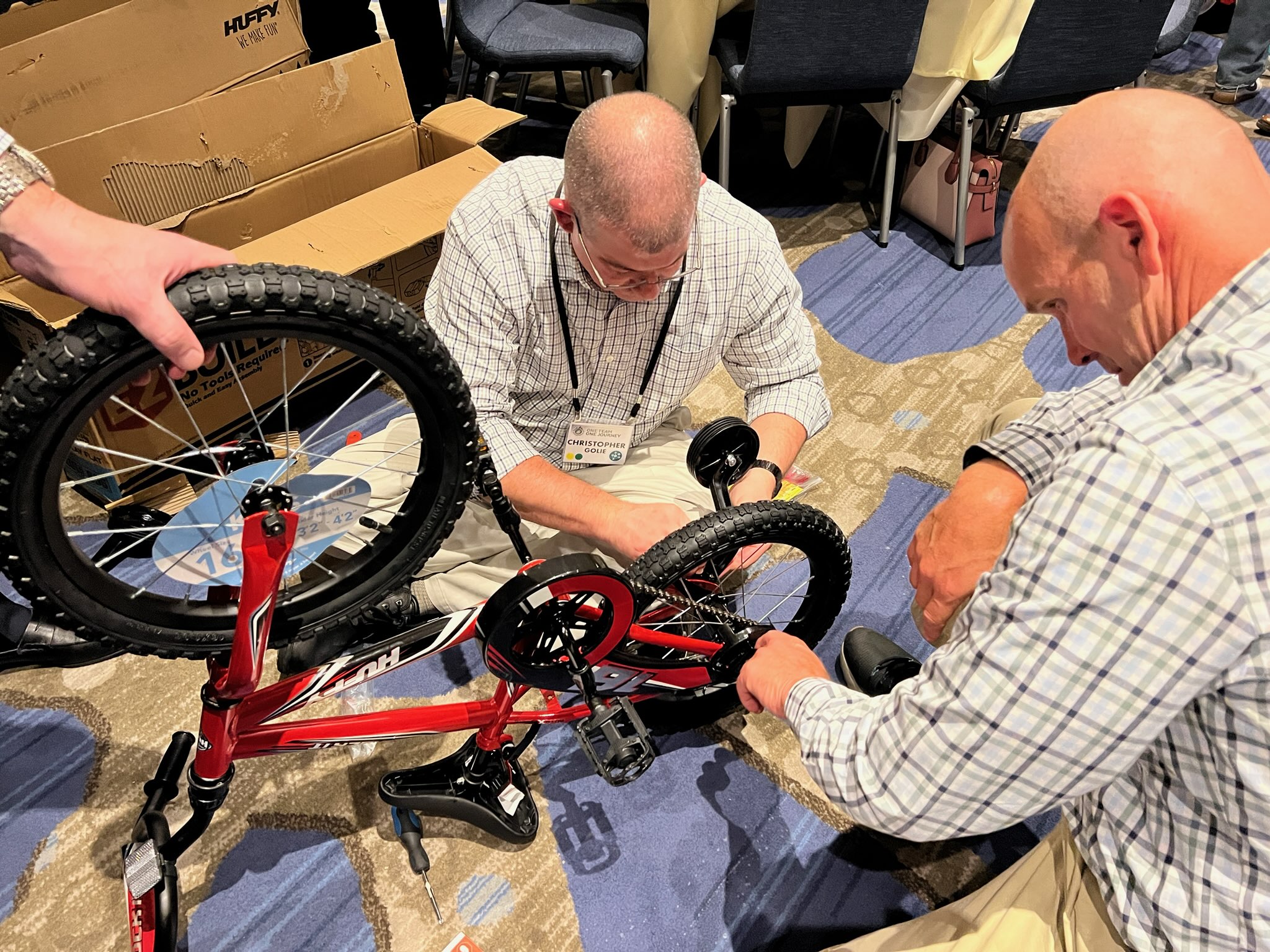
The best team building activities for tech companies give people a problem they cannot solve by working in isolation. Strong formats create constraints, dependencies, testing, iteration, and information sharing, the same kinds of behaviours engineering, product, design, and operations teams rely on when real projects cross functional boundaries.
At Team Building Nation, we prefer collaborative team building activities that give technical teams something tangible to figure out together. The activity can still be fun and competitive, but the strongest programs require teams to plan, build, communicate, test an idea, learn what failed, and try again.
That feels much more natural for a tech organization than asking employees to participate in an activity with no clear problem to solve.
Why Tech Team Building Needs More Than a Clever Game
Tech teams usually do not lack problems to solve. What they often lack is a low-stakes environment where people can see how they solve problems together.
Day-to-day work can hide team dynamics.
Engineers may spend long stretches working independently. Product and design can interpret the same requirement differently. Distributed teams may communicate efficiently in tickets and Slack while rarely getting to know how colleagues think in person.
A useful event exposes some of those patterns without attaching them to a product launch, customer issue, or missed deadline.
That is why we look for activities with:
- a clear objective;
- limited resources or time;
- multiple possible solutions;
- dependencies between people or teams;
- room to test and improve;
- different roles for different strengths;
- a visible result.
Those mechanics create collaboration without forcing it.
Five Team Building Activities for Tech Companies That Reward Creative Thinking
The programs below fit technical teams for different reasons. Some mirror systems thinking. Others create rapid prototyping, cross-functional work, or information exchange.
1. Project Pipeline: Build a System, Not Just a Piece
Project Pipeline is a strong fit for engineering and software-minded teams because the final result depends on interfaces.
Small groups receive materials such as bamboo, PVC, and tying supplies. Each group builds part of a larger delivery system designed to move marbles through the complete pipeline using gravity.
A team can build an excellent individual segment and still fail if its output does not connect properly with the next group.
That is what makes the activity interesting.
Participants have to think locally and globally at the same time. They plan their own section, communicate requirements, test weak points, and adjust the system before the full run.
For team building for engineering teams, that is a familiar challenge in a completely different medium.
2. Bridge to the Future: Put Design and Engineering on the Same Project
Bridge to the Future intentionally divides responsibilities.
Participants build sections of a functional bridge using simple materials. Part of each team focuses on construction, while others work on design and a shared visual concept. Team leaders reconnect throughout the program to coordinate progress and alignment.
The value is not that employees learn how to build a cardboard bridge.
It is that people with different responsibilities have to produce one coherent result.
That makes it particularly useful for product organizations where engineering, design, product management, marketing, or leadership need to work toward the same outcome without approaching the problem in the same way.
3. Competition to Collaboration: Make Knowledge Sharing the Win Condition
Most companies say they want people to share best practices. Competition to Collaboration turns that behaviour into the structure of the activity.
Teams first attempt challenges independently and work through multiple rounds of continuous improvement.
Then the rules change.
Groups are paired and have to exchange what they learned so another team can beat its previous performance. Success is no longer based only on what your own team can accomplish.
For technical organizations dealing with silos, this is one of the more relevant collaboration activities for tech teams because it changes the incentive.
Knowing something is not enough. You have to transfer that knowledge clearly enough for another group to use it.
4. Project Catapult: Rapid Prototype Under Constraints
Project Catapult gives teams a timed design-and-build challenge: construct a functioning catapult, test it, then compete on distance and accuracy.
The task is straightforward. The solution is not.
Teams need to divide responsibilities, interpret available materials, make design decisions, build quickly, and see whether their assumptions survive testing.
That makes Project Catapult one of the more natural engineering team building activities for groups that enjoy experimentation.
There is also something useful about moving technical thinking away from a screen.
A physical prototype makes failure visible immediately. If the design does not work, there is no long debugging document to hide behind. The team has to look at what happened, make an adjustment, and try again.
5. Teamwork: Mural: Give the Creative Side of the Company More Room
Not every tech team needs another engineering challenge.
Teamwork: Mural gives employees separate pieces of a larger visual project. Individual canvases are painted and later assembled into one complete mural that can incorporate company branding, values, words, or a shared visual theme.
This is useful for product, UX, creative, marketing, and mixed cross-functional groups because the task shifts attention from technical optimization to interpretation and visual collaboration.
It also gives employees who may not naturally take the lead in a logic-based challenge another way to contribute.
Creative collaboration works better when every activity does not reward the same type of thinker.
Compare Tech Team Building Activities by the Behaviour You Want
The right program depends on what you want employees to practise.
| Team Need | Program | What the Team Has to Do |
|---|---|---|
| Systems thinking | Project Pipeline | Connect individual components into one working system |
| Product/design alignment | Bridge to the Future | Coordinate different roles around one shared deliverable |
| Knowledge transfer | Competition to Collaboration | Share best practices so another group improves |
| Rapid prototyping | Project Catapult | Design, test, diagnose, and iterate |
| Creative collaboration | Teamwork: Mural | Contribute separate work to one visual result |
| Cross-functional connection | Mixed collaborative formats | Use different strengths toward one common objective |
This is why we do not think there is one “best” option for every technology company.
The problem you want the event to address should choose the format.
Match the Activity to the Type of Tech Team
Tech team building activities work better when planners think about who is actually in the room.
Engineering Teams
Engineering teams often respond well to constraints, testing, measurable outcomes, and systems where one decision affects another.
Build challenges and iterative formats fit naturally.
Product and Design Teams
Product and design groups may benefit more from activities where interpretation, creativity, communication, and integration matter as much as technical execution.
Cross-Functional Product Teams
For groups combining engineering, design, product, customer success, sales, and operations, the strongest format usually gives different skills equal value.
This is where Bridge to the Future or Project Pipeline can expose how much one group depends on another.
Company-Wide Tech Events
An all-hands event requires a format that scales without turning most employees into spectators.
Team Building Nation designs programs for groups ranging from small teams to thousands of participants, so the structure can be adapted around group size, venue, timeframe, and production requirements.
Our guide to what makes corporate team building genuinely effective goes deeper into why the objective needs to come before the activity.
Do Not Turn the Activity Into a Simulation of Work
There is an important balance here.
A tech event should use behaviours that matter at work without feeling like employees have been invited to another meeting disguised as team building.
We do not need to ask engineers to code together during their offsite to work on collaboration.
A marble pipeline can expose dependencies.
A catapult can create rapid iteration.
A bridge can make cross-functional alignment visible.
The point is to give people a new context where familiar team behaviours emerge naturally.
That is often when employees notice them.
Build in Iteration Instead of One Shot at Success
One feature we particularly like for tech teams is the ability to attempt, learn, and retry.
When a group gets one instruction, completes it, and waits for a score, there is limited room for learning.
Iteration changes the conversation.
After a first attempt, teams can ask:
- What assumption was wrong?
- Where did information fail to move?
- Did we assign the right roles?
- Which part of the design became the bottleneck?
- Who identified the problem?
- What should we change before testing again?
Those questions sound familiar to anyone who works in technology, but the stakes are completely different.
Nobody is fixing production.
That makes experimentation easier.
Give Hybrid and Distributed Teams a Shared Reference Point
Many tech teams have another challenge: employees may work together constantly without spending much time together physically
A well-run event creates shared history.
It gives people something outside the normal project context to reference later: the bridge that almost collapsed, the redesign that fixed the pipeline, the idea another department contributed, or the strategy that changed after the first round.
That shared experience does not magically fix team culture.
But it gives relationships another layer beyond tickets, video calls, and deadlines.
For distributed organizations, that can make in-person time more useful.
How We Choose the Right Program for a Tech Company
At Team Building Nation, we do not start by assuming every tech company should do the same activity.
We look at the team.
Before recommending a program, the useful questions are:
- How many people are participating?
- Which departments or functions will be together?
- Is the team fully in-person, hybrid, or distributed?
- Does the group already know one another well?
- Is the main goal creativity, communication, trust, knowledge sharing, or connection?
- How much time is available?
- What kind of venue do you have?
- Are there accessibility or physicality requirements?
- Should the activity be collaborative, competitive, charitable, or a combination?
Those answers matter more than whether an activity is currently trendy.
Give Your Tech Team a Problem Worth Solving Together
At Team Building Nation, our Game Engineers have spent more than 15 years designing facilitated corporate experiences around communication, creativity, collaboration, and shared problem-solving.
For technology teams, the strongest events rarely come from adding more complexity.
They come from giving people a clear objective, enough constraints to make the problem interesting, and a reason to depend on one another.
The best team building activities for tech companies create a result nobody in the room could have produced alone.
That is the kind of collaboration worth building.