Remote teams connect, communicate, and perform better when they play together. The right virtual team building games give employees a shared experience that builds trust and sharpens collaboration skills.
This guide covers what makes virtual games effective, which formats deliver the best results, and how to choose the right experience for your team.
What Makes Virtual Team Building Games Actually Work
Not every virtual game builds teamwork. The ones that do share a few things in common.
They require real communication. Players have to talk to each other, share information, and coordinate decisions. That kind of active participation is what strengthens working relationships.
They create stakes. Low-pressure competition keeps energy high and gives people a reason to stay focused. Teams that are genuinely trying to win are also genuinely paying attention to each other.
They are easy to join. The best virtual team activities have a low technical barrier. If employees need 20 minutes of setup, half the room is already disengaged before the game starts.
When these three elements come together, virtual games stop being a box to check and start being an experience people actually talk about afterward.
Why Collaboration Improves After Team Games
Shared play builds psychological safety. When people laugh together, struggle together, and celebrate together in a low-stakes environment, they become more comfortable doing those things at work.
Research in organizational psychology consistently shows that informal interaction between coworkers increases trust, reduces conflict, and improves information sharing. Virtual team games are a structured way to create that informal interaction, even across time zones.
Key signs a virtual game has real collaboration value:
- Teams must divide tasks and rely on each other
- Players share information that no one person holds alone
- Roles shift so everyone contributes
- The game rewards communication over individual skill
- Teams debrief or react together at the end
How Often Remote Teams Should Play Together
Most team-building experts recommend structured social activities once a month for remote teams. Quarterly sessions work for teams that interact frequently in other ways.
The goal is consistency. A one-time event builds a moment. A recurring rhythm builds a culture.
It also matters when you schedule these sessions. Teams that play together at the start of a new quarter carry that energy into their planning conversations. Teams that celebrate together at the end of a project close the loop in a way that reinforces why the work mattered.
The format matters less than the frequency. A well-run 45-minute virtual game done consistently does more for team cohesion than an elaborate annual retreat that no one talks about four weeks later.
The Best Virtual Team Building Games for Collaboration
The formats below are the most effective for distributed teams that want to build real working relationships, not just have a fun hour.
Game Show Feud Brings Friendly Competition to Remote Teams
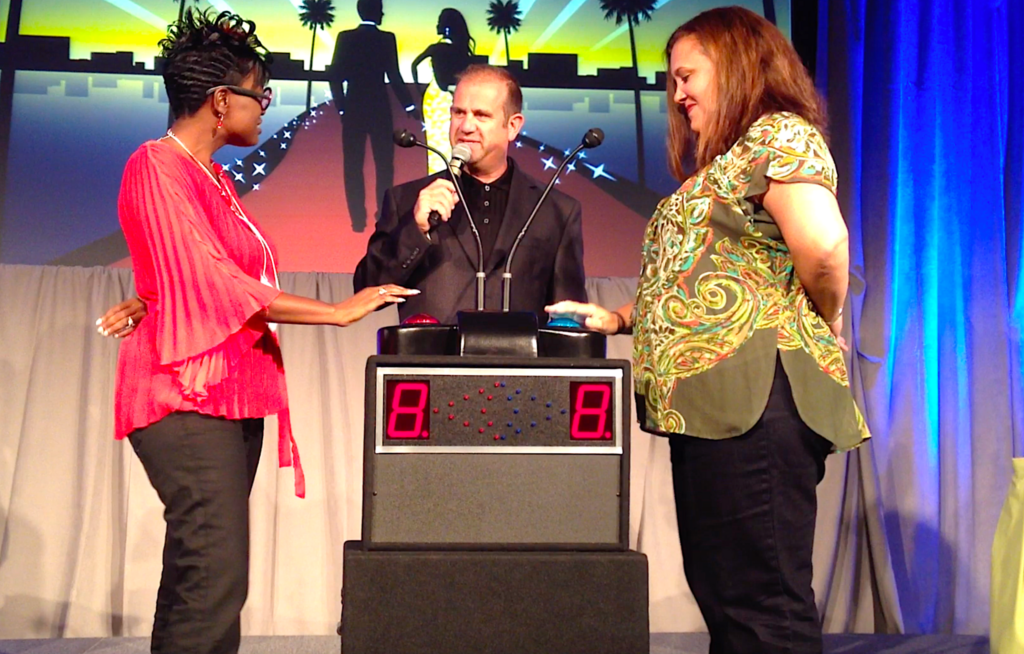
The Game Show Feud puts teams head to head in a fast-moving survey-style competition. Players predict how the majority of people answered a question, then match their answers against the results.
It works because it has no technical skill requirement. No one wins because they know more facts or have faster reflexes. Teams win by thinking like other people, which is exactly the kind of perspective-taking that makes better collaborators.
A live host runs the session, keeps energy high, and handles all the logistics. Your team shows up, gets split into groups, and competes across multiple rounds.
Game Show Feud is well suited for large groups. It scales without losing the head-to-head competitive feel that makes it engaging.
What teams get out of it:
- A high-energy shared experience that generates real laughter
- Perspective-taking practice disguised as a game
- Natural conversation starters that carry into the workday
- An experience accessible to every personality type
This format works especially well for onboarding events, company-wide kickoffs, and end-of-quarter celebrations. It is also one of the few virtual team activities that generates genuine excitement in groups that are normally hard to engage. The survey format creates immediate debate. Teams argue over answers, predict what other people said, and discover surprising things about how their colleagues think.
That surprise is productive. It gives people something real to talk about when they return to their regular work context.
In It to Win It Builds Real Team Coordination Under Pressure
In It to Win It is a relay-style challenge where teams race through a series of rapid-fire mini games. Each round is short, physical enough to be exciting, and different enough to keep everyone guessing.
The format rewards adaptability. Teams that communicate clearly and reassign roles between rounds perform better than teams where one person tries to do everything. That mirrors exactly how high-performing teams operate at work.
The relay structure means engagement stays constant. No one is sitting out while one person takes a turn. Everyone is either playing or coaching the person who is.
This program is one of the most effective options for teams that want something that feels genuinely fun rather than corporate. The format is borrowed from real game show television, which gives it a recognizable energy that employees connect with immediately.
In It to Win It is a strong fit for mid-size teams and departments that want to build coordination across functions, especially when teams are newly formed or recently reorganized.
The game also travels well across cultures. Because it is built around physical challenges and speed rather than language or trivia, international teams with mixed native languages consistently report that it is one of the most inclusive formats they have tried.
Virtual Team Building Games vs Other Remote Engagement Ideas
Virtual games are not the only tool for remote team engagement, but they are one of the most efficient. Happy hours require no shared activity and often feel forced. Lunch and learns are one-directional. Workshop-style sessions are valuable but demand a lot of cognitive energy.
A well-designed virtual team game does something different. It creates an equal playing field where hierarchy fades, introversion is less of a disadvantage, and the only thing that matters for the next 60 minutes is how well the group works together.
That shared experience is what carries back into the real work. Teams that have competed together, laughed together, and figured something out together tend to communicate with less friction when stakes are higher.
The Role of a Live Host in Virtual Team Games
A professional host transforms a virtual game from an awkward video call into a real event. Facilitation is a skill. Reading energy through a screen, managing turn-taking across multiple breakout rooms, and keeping 50 or 100 people engaged at the same time requires experience that most internal organizers do not have.
The best virtual team building providers include a dedicated host as part of the experience. That host handles the pacing, manages the technology, and brings energy that no slide deck can replicate.
When evaluating virtual team building vendors, ask specifically about their host training process and whether hosts are full-time facilitators or contractors brought in per event. The answer tells you a lot about the quality you can expect.
The right game depends on three things: your group size, your goal, and your team’s energy level.
For large company-wide events, competitive survey formats like Game Show Feud scale without losing engagement. Everyone can participate regardless of role, seniority, or technical comfort.
For smaller teams focused on coordination and communication, high-activity relay formats like In It to Win It generate the kind of pressure that reveals how people work together.
For teams that are brand new, start with something that creates shared laughter quickly. Trust comes from positive shared experience, and laughter is the fastest path to it.
Questions to Ask Before Booking a Virtual Team Activity
Before choosing a format, answer these questions with your organizer:
- How many participants will join live?
- Is this a recognition event, a culture event, or a training event?
- Does your team prefer competitive or collaborative formats?
- What tech tools does your team already use comfortably?
A good virtual team building provider will ask these same questions. The answers shape everything from format to pacing to how the host runs the session.
How Team Building Nation Delivers Collaborative Virtual Experiences
At Team Building Nation, we design every program around one outcome: teams that leave feeling more connected than when they arrived. Our hosted virtual sessions are fully managed, so you have no logistics to handle on your side.
Our facilitators are experienced at reading remote rooms. They adjust pacing, manage energy, and make sure everyone is included, whether your team has 10 people or 300.
Every program we run is built to create real interaction, not just entertainment. The games we host are proven to start conversations that continue long after the session ends.
If you are planning a virtual event for your team and want to know which format fits your group best, reach out. We will ask the right questions and match you with an experience your team will still be talking about next quarter.